
Data Literacy Skills@OWL – Data literacy for East Westphalia-Lippe – and beyond
The project was completed on 31 December 2023. DaLiS@OWL received funding from 2020 to 2023 as part of the DH.nrw funding programme run by the Ministry of Culture and Science of the State of North Rhine-Westphalia. The OER produced as part of the project can be found on the platform twillo.de.
In our increasingly data-driven world, the self-directed and secure handling of data is becoming a key competence – not only in academia and the labour market, but also in the ongoing development towards a digitalised society. The COVID-19 pandemic has, if nothing else, made it clear just how important data literacy is for each and every one of us. Data literacy has enabled us to understand the significance of key indicators such as the R value, the positivity rate or the seven-day incidence rate, and to make sense of media reports on scientific findings regarding the coronavirus. Consequently, the aim of the cross-university collaborative project DataLiteracySkills@OWL, involving the Universities of Bielefeld and Paderborn as well as Bielefeld University of Applied Sciences, was to strengthen data literacy skills.
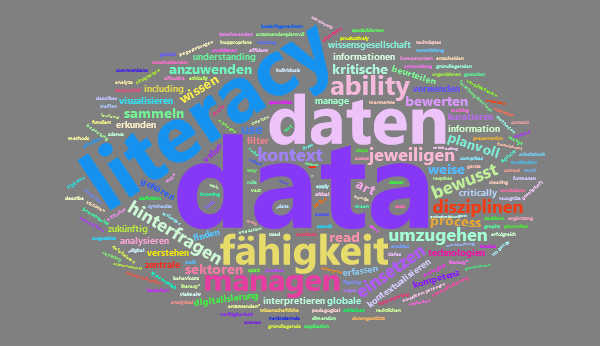
Data literacy, in this context, is the ability to handle data in a systematic and reflective manner, and to use and scrutinise it consciously within the relevant context: Where can suitable data be found? How is data collected and analysed? In what contexts may which data be used? What ethical criteria must be observed? The collection and administration of data, right through to its critical evaluation and application, require fundamental skills. Students need these skills to be able to act effectively in both academic and societal contexts across all sectors and disciplines in the future, and to help shape the digital transformation.
The aim of DataLiteracySkills@OWL was therefore…
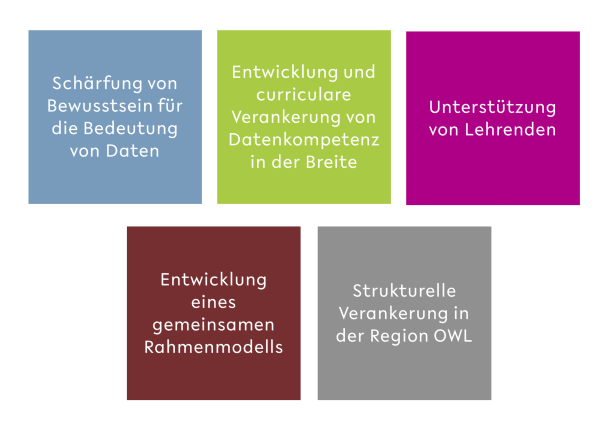
… to prepare students across all disciplines for the demands of a data-driven professional world and society by embedding the teaching of data literacy skills within the curriculum, through application-oriented, inter-institutional and interdisciplinary programmes on offer.
… to enable teaching staff to deliver data literacy skills through systematic exchange between data-centred and non-data-centred disciplines, access to digital tools, the creation of enduring teaching resources and targeted incentives.
… to create a reliable certificate of competence for data-literate graduates in the OWL region – in the form of an OWL Data Certificate tailored to the regional economy and academic community – and to ensure a sustainable knowledge transfer. Even beyond the OWL region.
Project and Team
Partners in the consortium: three universities
Consortium leader: Bielefeld University
Total funding: €880,000
Funding body: MKW NRW, ‘Data Literacy Education.NRW’ funding programme as part of the state-wide digitalisation initiative in collaboration with DH.NRW
Further information: Data Literacy Education.NRW
Name: Dr Katharina Weiß
Email address: katharina.weiss@uni-bielefeld.de
Role: Coordinator, DataLiteracySkills@OWL
About Katharina Weiß: After studying psychology at Bielefeld University, Katharina Weiß completed her PhD in cognitive psychology at Paderborn University. She subsequently conducted research in experimental cognitive psychology at Leuphana University Lüneburg and Bielefeld University, focusing on topics including visual attention, time perception and eye movements. She brings her expertise in data-related experimental psychological research and cognitive psychology teaching to the DataLiteracySkills@OWL project.
Name: Marcel Gemander
Email address: marcel.gemander@uni-bielefeld.de
Role: DataLiteracySkills@OWL coordinator
About him: Marcel Gemander studied Business Administration and Economics at Bielefeld University and Visual Communication at Bielefeld University of Applied Sciences. His great passion for data visualisation is reflected in his winning the Lucky Strike Award for Young Professionals and his nomination for the German Design Award Newcomer of the Year 2019. He brings his expertise in online data visualisation and his experience in data storytelling to the DataLiteracySkills@OWL project.
Name: Dr Juliane Theiß, until February 2022
Email address: juliane.theiss@uni-bielefeld.de
Role: DataLiteracySkills@OWLcoordinator
About her: Before moving to the beautiful OWL region, Juliane Theiß studied biology at the University of Hamburg and conducted research for her PhD in virology at the University Medical Centre Hamburg-Eppendorf and at the Heinrich Pette Institute, Leibniz Institute for Experimental Virology. Drawing on her own work with complex datasets from high-throughput sequencing, she has developed a passion for data literacy education and brings to the DaLiS project, in particular, her experience in coordinating university-wide projects and in interdisziplinäre collaboration.
Name: Prof. Dr Tobias Matzner
Email address: tobias.matzner@uni-paderborn.de
About the author: Tobias Matzner studied Computer Science and Philosophy in Karlsruhe, Rome and Berlin. After completing his PhD at KIT in Karlsruhe, he conducted research at the International Centre for Ethics in the Sciences in Tübingen and at the New School for Social Research in New York. Since 2017, he has been Professor of Media, Algorithms and Society in Paderborn. In the DaLiS project, he is investigating the intertwining of technical, social and cultural logics.
Name: Dr . Gudrun Oevel
Email address: gudrun.oevel@upb.de
Name: Dr Annika Bush (2020–2022)
Email address: annika.bush@upb.de
About the author: Annika Bush studied biology, history and educational sciences at Bielefeld University and the Universidad de Panamá (Panama), and completed her PhD at the Faculty of Biology in Bielefeld. Her research focuses on sustainability in the context of digitalisation and social media, as well as interpersonal cooperation. She contributes her expertise in didactic and interdisziplinär topics to the DaLiS project in particular.
Name: Sonja Dolinsek (2022–2023)
Email address: sonja.dolinsek@uni-paderborn.de
About Sonja Dolinsek: Sonja Dolinsek studied History and Philosophy at Humboldt University in Berlin and Brown University, as well as International Relations at the University of Bologna and the IEP Rennes. She is currently working towards her PhD at the History Seminar at the University of Erfurt. Most recently, she worked as a research assistant at the German Digital Library. Within the DaLiS project, she contributes transdisciplinary perspectives on data and knowledge, as well as expertise in higher education pedagogy.
Name: Birte de Gruisbourne (2020–2023)
Email address: bdg@uni-paderborn.de
About the researcher: Birte de Gruisbourne studied Philosophy and theatre studies at the Free University of Berlin and Humboldt University of Berlin. Her research focuses on affect theory, social philosophy and ethics, as well as the philosophy of science. Within the DaLiS project, her ethical, social-philosophical and epistemological approach assists in the critical reflection on the concept of data, data practices and their integration into social contexts.
Name: Christian Schulz, until July 2021
About the researcher: Christian Schulz studied Media Studies, history and literature at the University of Siegen. His research focuses on social media and media theories, data practices, theories of affect and the subject, and digital photography. For the DaLis project, his work focuses on the epistemology and ethics of data practices and their infrastructures, as well as the use and (critical) reflection on digital methods.
Name: Prof Dr. iur. Daniel Antonius Hötte
Email address: daniel.hoette@fh-bielefeld.de
Role: Professor of Business Law, co-project lead at the FHB About the person: After completing his studies and PhD in Münster, Daniel Antonius Hötte worked as a solicitor at Freshfields Bruckhaus Deringer in the IP/IT department in Cologne and Düsseldorf. His research focuses in particular on legal issues relating to digitalisation and the future of legal practice; he advises companies, law firms and federal and state authorities on issues of digitalisation in the legal sector; and, as a Digital Fellow of the Stifterverband (2018, 2019), he develops innovative, digital teaching formats, working alongside start-ups and established players from the business world, amongst others.
Name: Lotte Prädikow, M.A.
Email address: lotte.praedikow@fh-bielefeld.de
About the author: Lotte Prädikow studied Business Psychology (B.Sc.) and Human Resource Management & Organisation (M.A.) at Bielefeld University of Applied Sciences. Since 2016, as a research assistant at the ‘Digitalised World of Work’ think tank at Bielefeld University of Applied Sciences, she has been investigating the impact of digitalisation and artificial intelligence technologies on employee skills, leadership, organisation and human resources management.
Name: Ass. iur. Arthur Felk, until April 2022
Email address: arthur.felk@fh-bielefeld.de
About the author: Following his law degree and legal traineeship, Arthur Felk has been involved in, amongst other things, interdisciplinary IoT and AAL research projects and, together with Prof. Dr Hötte, is examining the consequences of digitalisation at the interface between technology, law and business. As part of his independent PhD research at the University of Bielefeld, he is investigating specific aspects of contract law relating to smart products in the IoT.
Regarding support structures at the university (HSBI): Project responsibility at the HSBI lies with Prof. Dr Ulrich Schäfermeier, Vice-President for studies and teaching, who is supported by Dr Barbara Junge, Section of Planning, Controlling and Quality Management, and project manager for “QSys² – New Impulses for the QM System in studies and teaching”. In this way, the FHB ensures a holistic, cross-departmental and cross-divisional implementation of the DaLiS@OWL project objectives.
Publications
Theiß, J. (2020). Raising awareness of the importance of data – Why data literacy education is important and how data literacy impacts other key competences of the future. DUZ Wissenschaft & Management, 9|2020, 22–24.
Hachmeister, N., Weiß, K., Theiß, J., & Decker, R. (2021). Balancing Plurality and Educational Essence: Higher Education Between Data-Competent Professionals and Data Self-Empowered Citizens. Data, 6(2), 10. http://dx.doi.org/10.3390/data6020010
Working paper: Data Literacy: Competence Framework for Higher Education Institutions (as at 21 September 2021)
Further information on data literacy
Contact
Dr Katharina Weiß
Data Literacy Education coordinator
Section for Digital Transformation and Process Organisation / Information Management
Bielefeld University
Universitätsstraße 25
33615 Bielefeld
Telephone: +49 521 106-86547
Email: katharina.weiss@uni-bielefeld.de